The Family in the Line of Fire — The Invisible Partners in the Journey
- Ofer Goren
- 7 days ago
- 4 min read


When people talk about COPD or lung transplantation, they usually focus on the “hero.”
The one lying on the operating table.
The one counting pills into little plastic boxes.
The one stopping halfway up the stairs pretending to admire the architecture while secretly negotiating with his lungs.
But let’s move the spotlight for a moment.
Because the real story is never only about the patient.
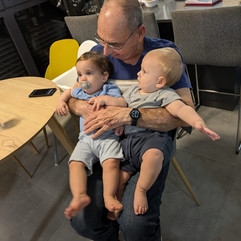
My wife Shoshi, my children, the grandchildren — they are not the audience in this story.
They are active participants in every crisis, every collapse, every tiny victory measured in oxygen saturation percentages and quiet mornings.
They live this disease too.
Just without the equipment attached to their faces.
Family becomes the anchor. But let’s not romanticize it too much.
Anchors also absorb impact.
When things become difficult, they are the ones standing closest to the explosion.
When I become irritable because the air does not go in properly, they absorb it.
When I sink into that strange low-glucose melancholy — my blood sugar drifting toward 70 while my brain starts writing Scandinavian crime drama scripts — they are the ones trying to pull me back out.
Usually while pretending it costs them less emotionally than it actually does.
Modern medicine has finally started recognizing something patients understood long ago:
Chronic illness never affects only one person.
The term “Compassion Fatigue” sounds very academic and respectable. “Secondary Trauma” sounds even more sophisticated.
In practice, it means this:
When one person in the house cannot breathe properly, eventually nobody relaxes properly.
Neurological and hormonal studies show that caregivers often develop stress responses synchronized almost perfectly with the patient’s condition.
When my saturation alarm started beeping at home, Shoshi’s cortisol probably climbed exactly alongside mine.
That stress is not metaphorical.
It is physiological.
Sleep disturbances. Anxiety. Hypervigilance. Emotional exhaustion.
Studies involving families of lung transplant recipients consistently show elevated rates of depression and chronic stress among spouses and caregivers. Sometimes levels remarkably similar to the patients themselves.
Which honestly makes perfect sense.
One person survives the illness.
The other survives the constant fear of losing them.
Different trauma. Same house.
There is also a statistic doctors like quoting because it sounds encouraging:
Strong family support significantly improves survival rates after lung transplantation.
Some studies estimate by nearly thirty percent.
Amazing statistic.
But statistics rarely mention the invisible cost attached to it.
Nobody measures how many nights the spouse sleeps lightly listening for cough changes.
Nobody measures the exhaustion of pretending optimism for years.
Nobody measures the psychological wear of living permanently “on alert.”
Caregiving is a strange profession.
No training.
No salary.
No retirement plan.
Mostly paperwork and anxiety.
In our house, we developed a survival style that probably looks slightly inappropriate from the outside.
We do not do much emotional theater.
No inspirational speeches. No dramatic declarations about “winning the battle.”
Honestly, the disease already takes enough energy. We cannot also run a motivational conference.
Our rule became radical honesty.
If things are bad, we say they are bad.
If I feel weak, frightened, exhausted, angry — we say it directly.
My cautious optimism was not born from positivity.
It came from repeated negotiations with reality.
Shoshi never treats me like fragile porcelain.
Which is probably why I survived this psychologically.
If I start drifting too deeply into self-pity, she reminds me — not gently — how far we already came.
And strangely, humor became part of the treatment plan.
Not cheerful humor.
Dark humor. Bureaucratic humor. Hospital waiting-room humor.
The kind you develop after enough bronchoscopy appointments and insurance forms.
When we laugh at absurd medical bureaucracy or ridiculous transplant situations, we reclaim some control over the experience.
Humor reduces helplessness.
Science actually supports this too. Studies on coping mechanisms in chronic illness show that shared humor decreases stress hormone levels, improves resilience, and strengthens interpersonal bonding.
Apparently sarcasm is clinically useful. Finally, some scientific validation.
Our small sensory rituals became another escape route from illness.
A good meal.
Coffee outside.
A short walk in the garden.
Watching the grandchildren destroy the house with impressive energy while I quietly admire having enough breath to keep up with them for fifteen minutes.
These moments matter because illness cannot occupy every room in the house forever.
Otherwise it becomes the only language everyone speaks.
There is another thing families develop over time.
A kind of sixth sense.
My family can identify my “crashes” before I fully notice them myself.
If I become unusually quiet, answer too briefly, or start staring at nothing like a malfunctioning GPS system, somebody usually asks:
“Did you eat?”
Most of the time, they are right.
Low glucose. Exhaustion. Oxygen fluctuations. Infection starting.
They learned my patterns almost as carefully as the medical team did.
Without intending to, they became part of my monitoring system.
That creates a very strange intimacy.
Not romantic intimacy.
Operational intimacy.
A shared survival language.
The transplant, the rehabilitation, the blog, the routines, the fears — all of it slowly became a collective family project.
Not because anyone wanted that role.
Because reality assigned it.
So how do you protect a family inside this kind of storm?
First: communicate without filters.
People think silence protects loved ones.
Usually it does the opposite.
Silence creates empty spaces, and the human brain fills empty spaces with catastrophes far worse than reality.
Talk openly.
About rejection fears.
About infection fears.
About exhaustion.
About death sometimes too.
Not dramatically. Just honestly.
Second: create spaces where illness is temporarily banned.
Times when you are simply husband, grandfather, father, wife.
No medications on the table.
No oxygen discussions.
No reviewing blood tests during lunch like stock market reports.
Just ordinary life for an hour or two.
That normality matters enormously.
Third: acknowledge the effort.
Do not treat family support as automatic infrastructure.
The people standing beside chronic illness patients chose to remain in the line of fire every day.
That requires quiet courage.
Not cinematic courage.
Daily courage.
The repetitive kind.
The kind nobody applauds because it happens in kitchens, clinics, pharmacies, and sleepless nights.
My transplanted lungs allow me to breathe.
But my family gives meaning to that breathing.
Without them, survival would remain only biological.
And maybe that is the real truth beneath all the medicine, technology, statistics, and transplant science:
Even the best lungs in the world are still only bags of air unless there is love waiting around them.



Comments